Wondering if your toddler is talking enough? You’re not alone.
Some of the most common questions parents ask are:
- “When do kids start talking?”
- “Should my 18-month-old be saying more words?”
- “Is my toddler just a late talker?”
- “When should I see a speech therapist in Edmonton?”
If you’ve found yourself searching these questions, you’re in good company. Every week, families across Edmonton reach out because they’re wondering whether their child’s communication is developing as expected. While every child develops at their own pace, there are important speech and language milestones that can help you decide when it’s time to seek support.
The good news? Early support can make a significant difference and seeing a Speech-Language Pathologist (SLP) doesn’t automatically mean something is “wrong.” It simply means you’re getting expert guidance during one of the most important stages of your child’s development.
When Do Kids Start Talking?
Language development begins long before a child’s first word.
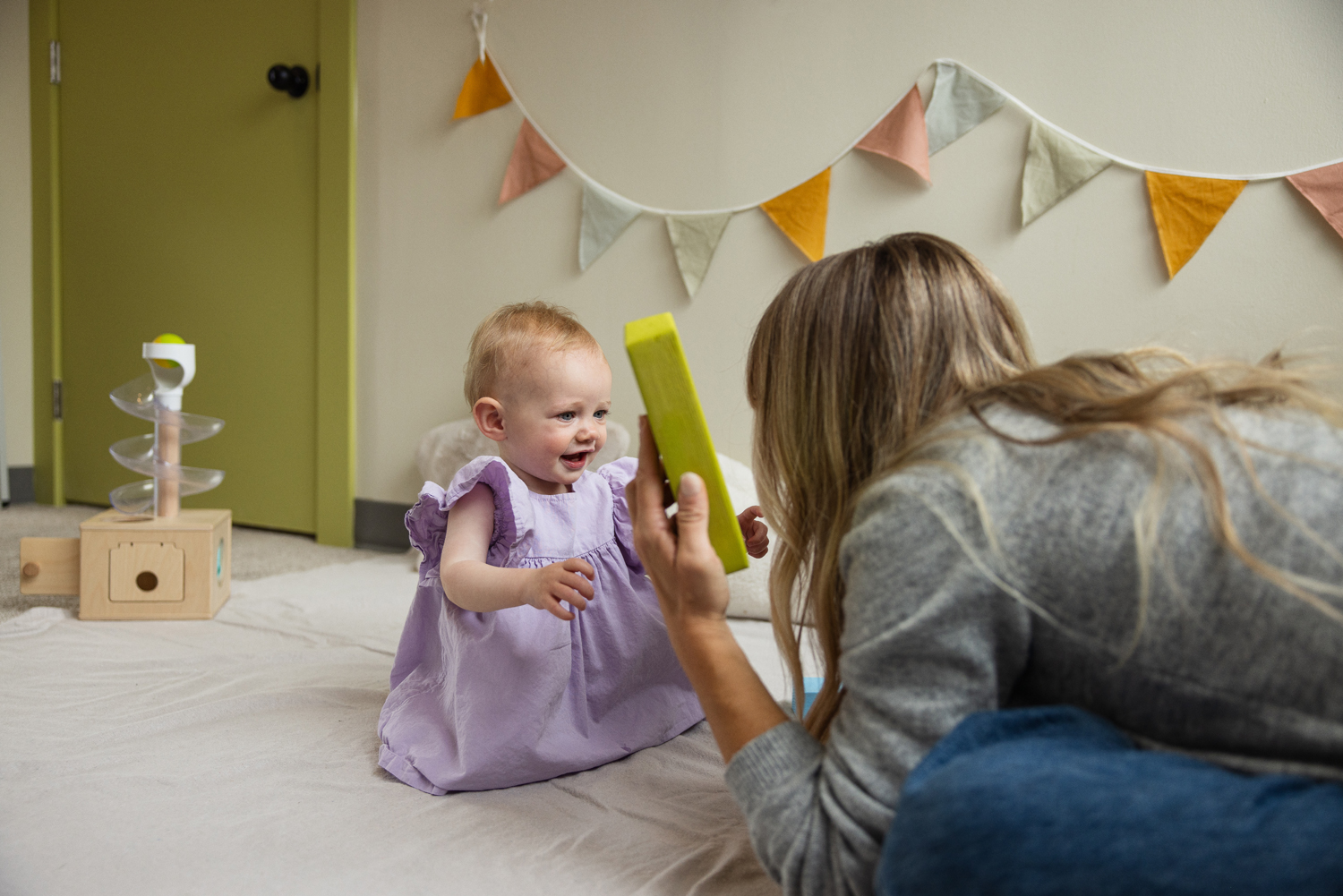
Even before babies can speak, they’re learning to communicate through eye contact, facial expressions, gestures, sounds, and interactions with the people around them.
Here’s what we generally expect to see.
Around 12 Months
By their first birthday, many children are:
- Babbling with a variety of different sounds (such as “mama” and “baba”)
- Responding to their name
- Understanding simple words like “no” or “bye-bye”
- Understanding simple questions like “where’s daddy?”
- Using gestures such as waving or pointing
- Saying one or two meaningful words
If your child isn’t yet talking there’s no need to panic, pay attention to how they’re communicating in other ways. Gestures are one of the most significant precursors to verbal language – limited pointing, showing, giving, and joint attention are increasingly recognized as early indicators of broader communication difficulties, sometimes preceding expressive language delays.
Around 18 Months
Many toddlers will:
- Say approximately 20–50 words
- Understand simple instructions
- Point to familiar objects
- Attempt to imitate words
- Use gestures together with words
This is often the age when parents first begin wondering if their child is a “late talker.”
Do not overlook receptive language! This may be more predictive of future language challenges than expressive language.
Children who both understand less and say less are at greater risk for persistent language disorders than those with isolated expressive delay
Around 24 Months
By age two, many children are:
- Using at least 50 words
- Beginning to combine two words (“more milk,” “mommy up”)
- Following simple directions
- Naming familiar people and objects
- Communicating wants and needs more independently
Children continue to develop at different rates, but if your toddler isn’t meeting several of these milestones, it’s worth speaking with a Speech-Language Pathologist.
Is My Child Just a Late Talker?
This is one of the most common questions we hear from Edmonton families.
The honest answer is:
Sometimes—but not always.
Research shows that some late talkers naturally catch up with their peers. Others continue to experience language difficulties that can affect later learning, literacy, and social development.
Unfortunately, no one can reliably predict which toddlers will catch up and which will benefit from additional support based on expressive vocabulary alone.
That’s why current research increasingly recommends early check-ins rather than simply “waiting and seeing.”
When Should I See a Speech Therapist?
You should consider contacting a Speech-Language Pathologist if your child:
By 12 months
- Isn’t babbling
- Doesn’t respond consistently to their name
- Rarely points, waves, or uses gestures
- Shows limited interest in interacting with others
By 18 months
- Uses very few words (<10-15)
- Doesn’t imitate sounds or words
- Has difficulty understanding simple directions
- Communicates mostly through crying or pulling adults toward objects
- Uses your hand as a tool to communicate
By 24 months
- Has fewer than approximately 50 words (the average is closer to 250!)
- Isn’t combining two words together (“mama help”, “more water”)
- Has difficulty understanding simple language
- Has stopped using words they previously used
If your child has lost speech or language skills at any age, they should be seen promptly.
Why Early Speech Therapy Matters
The first few years of life are an incredible time for brain development.
Children learn language through thousands of everyday interactions—during meals, playtime, bath time, reading books, and family conversations.
Research consistently shows that early intervention helps families:
- Build stronger communication skills
- Support social development
- Encourage play and interaction
- Reduce frustration
- Improve school readiness
One of the biggest misconceptions is that therapy only happens during appointments.
In reality, one of the most effective approaches involves coaching parents to support communication throughout everyday routines.
What Happens During a Speech-Language Assessment?
Many parents worry about what an assessment looks like.
In most cases, an SLP will:
- Observe your child’s play
- Ask questions about development
- Assess understanding and communication skills
- Look at gestures, play, attention, and social interaction
- Discuss whether therapy, monitoring, or simple home strategies are appropriate
Sometimes families leave feeling reassured that development is progressing normally.
Other times, they leave with practical strategies that can make a real difference.
Either outcome provides valuable information.
Should I Wait Until My Child Is Three?
This advice was common years ago.
Today, many Speech-Language Pathologists recommend seeking guidance much earlier if concerns arise.
Waiting may delay support for children who truly need it.
An early assessment doesn’t commit your child to therapy—it simply gives you more information and, if needed, access to strategies during a period when the brain is especially ready to learn language.
Supporting Your Child’s Language at Home
Simple, everyday interactions have a powerful impact.
Try to:
- Follow your child’s interests during play
- Talk about what they’re looking at and doing
- Read books together every day
- Pause to give your child opportunities to communicate
- Respond positively to all attempts at communication
- Expand on what your child says (“Car” becomes “Yes! A big blue car!”)
Small moments repeated throughout the day add up.
Looking for a Speech Therapist in Edmonton?
If you’re searching for:
- Speech therapist Edmonton
- Pediatric speech therapy Edmonton
- Toddler speech delay Edmonton
- Late talker Edmonton
- Speech-language pathologist Edmonton
- Child speech assessment Edmonton
- Early intervention Edmonton
- Language delay Edmonton
- Speech therapy near me
- When should my child start talking?
You’re already taking an important first step.
Whether your child simply needs reassurance or would benefit from early intervention, an assessment can help answer your questions and provide a clear plan.
Families across Edmonton, St. Albert, Sherwood Park, Spruce Grove, Beaumont, Leduc, Fort Saskatchewan, and surrounding communities often seek support during the toddler years because early guidance can make a meaningful difference.
Frequently Asked Questions
Is my 18-month-old supposed to be talking?
Many 18-month-olds use approximately 20–50 words and understand much more than they can say. If your child is using very few words or has limited understanding, it’s worth discussing your concerns with an SLP.
Is it okay if my toddler understands everything but doesn’t talk much?
Some children have strong understanding but delayed expressive language. While many make excellent progress, an assessment can help determine whether additional support would be beneficial.
Does seeing an SLP mean my child has autism or a developmental disorder?
No. Speech-Language Pathologists assess communication development across many areas. Many children seen by SLPs have isolated speech or language delays and do not have autism or another developmental diagnosis.
Can speech therapy really help toddlers?
Yes. Research consistently shows that early intervention—particularly when parents are coached to use evidence-based communication strategies during everyday routines—can improve language outcomes.
Ready to Learn More?
If you’re wondering whether your child’s speech and language development is on track, you don’t have to figure it out alone.
Early questions deserve early answers.
A Speech-Language Pathologist can help you understand your child’s strengths, identify any areas of concern, and provide practical strategies to support communication at home.
Whether your child needs reassurance, monitoring, or intervention, seeking advice early can provide clarity and peace of mind for your family.
Call us at (587) 449-0673 or email hello@dreampediatric.ca for more information.
Book your free phone consult at https.//dreampediatricservices.janeapp.com